


In the energy landscape of 2026, the definition of "high capacity" has evolved. As national grids integrate higher percentages of intermittent renewables, the requirements for large-scale power plants have shifted from simple baseload generation to a complex balance of efficiency, flexibility, and grid-forming capabilities. For industrial conglomerates and utility providers, choosing the right system is no longer just about the lowest Capital Expenditure (CAPEX); it is about the Total Cost of Ownership (TCO) and the ability to survive in a volatile, decarbonizing market.
When the demand exceeds 50 MW, the engineering choice typically narrows down to İki primary thermal technologies: Combined Cycle Gas Turbines (CCGT) and Large-Scale Reciprocating Engine Plants. Understanding the thermodynamic and operational trade-offs between these systems is essential for long-term asset viability.
Gas Turbines (CCGT): The Efficiency Giants
For massive, centralized power requirements—typically ranging from 100 MW to over 1 GW—Combined Cycle Gas Turbines (CCGT) remain the gold standard for high-capacity generation. The engineering of a CCGT plant utilizes a multi-stage energy recovery process. Initially, a gas turbine generates electricity through the Brayton cycle. Instead of exhausting the hot gases into the atmosphere, they are directed into a Heat Recovery Steam Generator (HRSG). This high-temperature energy boils water to create high-pressure steam, which then drives a secondary steam turbine (the Rankine cycle).- The Efficiency Advantage: Modern CCGT plants in 2026 can achieve net electrical efficiencies exceeding 62% to 64%. This makes them the most fuel-efficient thermal plants for steady, baseload operation.
- Best Use Case: Large metropolitan grids or heavy industrial zones that require massive, uninterrupted power with high reliability.
Reciprocating Engines: The Kings of Flexibility
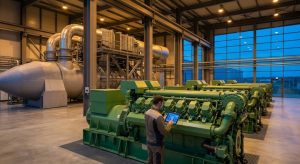
As the grid becomes more unpredictable, Large-Scale Reciprocating Engine Plants—utilizing multiple 10 MW to 20 MW units—have become a dominant force in high-capacity generation, particularly for "Peaker" and "Mid-merit" applications. In this architecture, power is generated through a modular array of high-efficiency, medium-speed internal combustion engines running in parallel. This allows the plant to scale its output with surgical precision, turning individual engines on or off to match the exact demand curve of the facility or the grid.- Operational Flexibility: Engines can reach full load from a standstill in less than 5 to 10 minutes. This allows operators to track the sharp "ramps" of solar and wind generation accurately.
- Efficiency at Part-Load: Unlike a single large turbine, a modular engine plant maintains high efficiency even at low plant loads. If only 20% of the power is needed, you simply run 20% of the engines at their "sweet spot" rather than running a massive turbine inefficiently.