


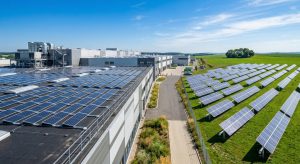
As commercial and industrial facilities in 2026 face increasing pressure to decarbonize and hedge against rising energy costs, solar photovoltaics (PV) have become the leading choice for on-site generation. However, the first fundamental decision an investor must make is spatial: Should the panels go on the roof or on the ground? While both systems utilize the same PV technology, their engineering requirements, permitting processes, and financial returns differ significantly.
Choosing the right mounting strategy depends on more than just available space; it requires an analysis of your facility's structural integrity, long-term land-use plans, and desired energy yield.
Rooftop Solar: Utilizing Idle Assets
Rooftop solar is the most common choice for urban and suburban commercial buildings, turning an otherwise unproductive roof surface into a high-performance energy generator.The Advantages
- Zero Land Requirement: Since the panels are installed on existing infrastructure, no additional land is needed. This is critical for businesses in industrial zones where land prices are high.
- Lower Installation Costs: Rooftop systems often have a lower Capital Expenditure (CAPEX) because they utilize the building's existing structure and are typically closer to the main electrical room, reducing the cost of cable runs.
- Protection for the Roof: A well-installed solar array can act as a shield, protecting the roof membrane from UV degradation and lowering the building's cooling load in the summer.
The Constraints
- Structural Limits: Not every roof can support the "dead load" of panels and the "wind load" of a mounting system. A structural audit is mandatory.
- Limited Space & Orientation: The system size is capped by the roof area. Furthermore, the orientation and tilt of the panels are often dictated by the roof's design, which may not be the optimal angle for maximum sun exposure.
- Maintenance Complexity: If the roof needs repair or replacement during the 25-year life of the system, the entire solar array must be dismantled and reinstalled at a significant cost.
Ground-Mounted Solar: Precision Engineering for Maximum Yield
Ground-mounted systems are typically preferred by large industrial facilities, manufacturing plants, or logistics centers with adjacent vacant land.The Advantages
- Optimal Performance: Unlike rooftop systems, ground-mounted arrays can be oriented perfectly south and tilted at the exact degree required for maximum annual yield.
- Ease of Maintenance: Accessing panels for cleaning or repairing inverters is much simpler on the ground. This often leads to higher system availability and lower long-term O&M costs.
- Tracking Technology: Ground-mounted systems can utilize single-axis trackers that follow the sun's path throughout the day, increasing energy production by up to 20% to 30% compared to fixed-tilt systems.
The Constraints
- Higher CAPEX: These systems require civil works, including trenching for cables and the construction of concrete or steel foundations.
- Land Opportunity Cost: Using land for solar means that land cannot be used for future warehouse expansions or parking.
- Permitting & Zoning: Ground-mounted projects often face stricter zoning laws and may require environmental impact assessments that rooftop systems bypass.
Key Comparison: Decision Factors for Businesses
Standardizing the choice between these two options requires looking at the technical and commercial variables side-by-side.Installation and Structural Requirements
Rooftop systems require a thorough structural audit to confirm the roof can handle the weight, whereas ground-mounted systems require geotechnical soil analysis to ensure the foundations are stable. If the building is old, rooftop solar might be impossible without expensive structural reinforcement.Energy Yield and Efficiency
Ground-mounted systems almost always win on efficiency. Because they are not constrained by a roof’s shape, they enjoy better airflow (keeping panels cooler) and can be perfectly aligned with the sun. If your goal is the absolute lowest Levelized Cost of Energy ($LCOE$), ground-mounted is usually the superior choice.Distance and Interconnection
A major hidden cost is the "AC cable run." Rooftop systems are usually very close to the facility's main distribution board. Ground-mounted systems may be several hundred meters away, requiring thick, expensive copper or aluminum cables and potentially causing higher voltage drops.The Verdict: Which One Should You Choose?
Choose Rooftop Solar if: * You have limited land or high land costs.- Your roof is new or in excellent structural condition.
- You want a faster, simpler permitting process.
- The primary goal is to offset a portion of your utility bill with minimal site disruption.
- You have unused land adjacent to your facility.
- Your roof is old, shaded, or structurally weak.
- You want to maximize energy production and reach carbon-neutrality goals faster.
- You want the flexibility of utilizing solar tracking systems.