


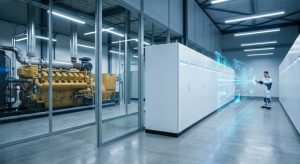
In the industrial landscape of 2026, energy continuity is no longer just a technical requirement; it is a fundamental pillar of competitive survival. As manufacturing becomes increasingly digitized and automated, even a transient voltage dip—lasting only milliseconds—can lead to catastrophic production stops, equipment damage, and millions of dollars in lost revenue. True power resilience in a modern facility requires moving beyond simple "backup" thinking and toward an integrated, proactive energy ecosystem.
Ensuring 100% uptime demands a multi-layered defense strategy that combines physical redundancy, rapid energy storage, and AI-driven intelligence. This guide outlines the essential pillars of industrial energy continuity.
The Hierarchy of Industrial Power Resilience
Achieving zero-downtime operations requires a "Defense-in-Depth" approach. Energy continuity is built in layers, starting from the most immediate response to long-term sustained generation.- Layer 1: Power Quality & Ride-Through (The Millisecond Response): Protecting sensitive electronics from sags and surges using active voltage regulators and high-speed UPS systems.
- Layer 2: Energy Storage Bridge (The Minute Response): Utilizing industrial BESS (Battery Energy Storage Systems) to carry the load instantly while secondary generation starts.
- Layer 3: Local Generation (The Hour/Day Response): Engaging on-site assets like gas engines (CHP) or diesel generators to provide firm, independent power.
- Layer 4: Intelligent Control (The Brain): An Energy Management System (EMS) that orchestrates these layers, managing synchronization and load shedding in real-time.
Hybrid Microgrids: The 2026 Standard
The most significant shift in industrial power resilience this year has been the move toward hybrid microgrids. Relying solely on a single utility connection or a standalone diesel generator is now considered a high-risk strategy. Modern facilities are integrating PV + BESS + CHP architectures. In this model, solar PV reduces operational costs, the Battery Energy Storage System (BESS) provides the instantaneous response needed for "black start" or "island mode" transitions, and the Combined Heat and Power (CHP) unit provides the high-density, reliable baseload energy required for 24/7 manufacturing. This hybridization ensures that if the grid fails, the facility switches to island mode operation seamlessly, with the battery bridging the gap before the engines hit full load.Advanced Redundancy: Moving to N+2 and Beyond
The traditional N+1 redundancy—where you have one spare unit—is increasingly being replaced by N+2 redundancy in mission-critical industries like semiconductor fabrication, food processing, and high-density data centers.- The N+2 Advantage: This allows a facility to have one unit offline for planned maintenance while still having a full backup unit available in case of a sudden failure in the primary fleet.
- Modular Design: By utilizing several smaller generating units rather than one massive engine, you increase the "granularity" of your redundancy. If one 1 MW engine fails in a 5 MW plant, you only lose 20% of your capacity, making it easier for the BESS and load-shedding systems to stabilize the remaining 80%.
AI and Digital Twins: Predicting Failure Before It Occurs
By 2026, AI-driven predictive maintenance has become the primary tool for ensuring energy continuity. Traditional "fixed-interval" maintenance is being replaced by real-time condition monitoring.- Digital Twin Integration: A digital twin of the facility's power network simulates "what-if" scenarios (e.g., "What happens if Transformer B fails during a peak solar window?"). This allows operators to identify vulnerabilities in the protection settings before a real-world event occurs.
- Acoustic & Thermal Sensors: AI algorithms analyze the sound frequencies of engines and the heat signatures of switchgear. Any slight deviation from the baseline is flagged as a potential failure, allowing for repairs during a scheduled weekend stop rather than an emergency Tuesday morning outage.
Critical Load Management and Smart Load Shedding
Not all industrial loads are created equal. In the event of a severe energy disruption where local generation cannot cover 100% of the demand, a smart load shedding strategy is essential to save the facility.- Critical Loads (Category A): Life-safety systems, control servers, and sensitive production machinery (e.g., cleanroom ventilation). These are never shed.
- Essential Loads (Category B): Primary production lines that can tolerate a brief stop but require a controlled shutdown.
- Non-Essential Loads (Category C): Administrative HVAC, lighting in warehouses, and electric vehicle charging stations.