


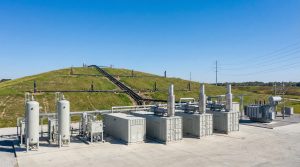
Municipal Solid Waste (MSW) landfills represent a significant source of anthropogenic methane emissions globally. For environmental engineers and waste management executives, the challenge is not merely containment but active mitigation. Methane (CH4), generated during the anaerobic decomposition of organic matter, possesses a Global Warming Potential (GWP) significantly higher than carbon dioxide. Uncontrolled venting of this gas constitutes a major environmental liability.
The most effective engineering solution to this challenge is the deployment of LFG Energy Systems. By capturing landfill gas and utilizing it as fuel in specialized internal combustion engines, facilities achieve two critical objectives: significant landfill methane reduction and the generation of renewable baseload power. This article analyzes the technical mechanisms of engine-based abatement and its impact on landfill gas to energy emissions profiles.
The Climate Challenge of Landfill Methane Reduction
Landfills function as large biochemical reactors. As organic waste decomposes in the absence of oxygen, it produces landfill gas (LFG), typically composed of 50% methane, 45% carbon dioxide, and 5% trace gases. The primary environmental objective is the destruction of the methane component.Methane's Greenhouse Gas Potency
To understand the necessity of landfill methane reduction, one must examine the GWP of methane. According to the Intergovernmental Panel on Climate Change (IPCC), methane traps heat approximately 28 to 34 times more effectively than CO2 over a 100-year period. Over a 20-year timeframe, this multiplier rises to over 80. Therefore, the release of raw LFG into the atmosphere is devastating from a climate perspective. Engineering strategies prioritize the conversion of CH4 into CO2 through combustion. While this process releases CO2, the net reduction in GWP is substantial because the resulting carbon dioxide is less potent than the original methane. This chemical conversion is the foundational principle of landfill gas to energy emissions control.LFG Collection and Pre-treatment Requirements
Effective reduction begins with efficient collection. Vertical extraction wells and horizontal trenches channel the gas to a central processing point. However, raw LFG is rarely suitable for direct injection into high-efficiency engines. It contains moisture, particulates, siloxanes, and sulfur compounds (H2S). Pre-treatment is mandatory.- Dehumidification: Removing water vapor prevents corrosion and combustion instability.
- Filtration: Removing particulates protects cylinder liners.
- Siloxane Removal: Activated carbon or regenerative media remove siloxanes. If not removed, siloxanes oxidize into silica (sand) inside the engine, coating valves and pistons, which leads to catastrophic failure.
Engine Technology: The Core Solution for Landfill Gas to Energy Emissions Control
While flaring destroys methane, it wastes the energy potential. Reciprocating internal combustion engines are the standard for LFG Energy Systems because they offer high electrical efficiency and robust performance under varying gas qualities.Combustion Efficiency and CO2 Equivalence
Modern gas engines designed for LFG application operate with lean-burn technology. They control the air-to-fuel ratio to minimize NOx emissions while ensuring complete combustion of the methane. The metric for success is the Destruction Removal Efficiency (DRE). A well-tuned engine achieves a methane DRE of over 98%. The engine converts the high-GWP methane into water vapor and biogenic CO2. Since the carbon in the waste was originally absorbed from the atmosphere by plants (biogenic carbon), the CO2 released during combustion is often considered carbon-neutral in many regulatory frameworks, unlike fossil fuel emissions. This conversion is the primary mechanism for landfill gas to energy emissions reduction.Operational Reliability and Uptime
Emission reductions are only calculated when the system is running. Frequent breakdowns lead to "fugitive emissions" if the flare backup system is not immediate. LFG-specific engines feature:- Reinforced Cylinder Heads: To withstand variable combustion pressures.
- Specialized Alloy Valves: To resist corrosion from trace acid gases.
- Advanced Knock Control: To adjust timing based on the fluctuating Methane Number (MN) of the gas.
Maximizing Environmental and Economic Benefits of LFG Systems
The transition from passive waste management to active energy generation creates a revenue stream that subsidizes environmental compliance.Regulatory Compliance and Carbon Credit Generation
Governments enforce strict limits on Non-Methane Organic Compounds (NMOCs) and methane emissions. LFG Energy Systems allow facilities to comply with these regulations (such as the Clean Air Act in the US or EU Landfill Directives). Beyond compliance, these systems generate distinct commodities:- Renewable Electricity: Sold to the grid via Power Purchase Agreements (PPA).
- Carbon Credits: Verified emission reductions can be traded on voluntary or compliance carbon markets. Each ton of methane destroyed generates credits based on its CO2 equivalent (CO2e).
- Renewable Energy Certificates (RECs): Monetizing the green attribute of the power generated.