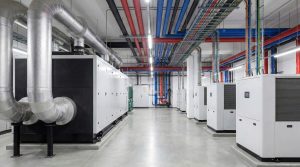
The hospitality industry operates as a unique energy consumer where the simultaneous requirement for uninterruptible power, continuous domestic hot water for guest comfort, and aggressive air conditioning loads creates a thermodynamic profile that demands a sophisticated, integrated energy solution rather than a collection of standalone utility connections. Hotel margins are thin. Energy costs are the second largest operational expense after labor. Reducing this cost requires precision engineering. We must analyze two competing technologies: Trigeneration (CCHP) and Industrial Heat Pumps.
The Engineering Context: Understanding Hotel Load Profiles
Defining the optimal energy architecture for a hotel requires a granular analysis of the "simultaneity factor" where the overlap between electrical demand and thermal consumption dictates the efficiency of the primary generation asset. Hotels differ from factories. They have 24/7 occupancy. They require massive amounts of sanitary hot water (DHW) regardless of the season. This constant thermal baseload is critical.
The Trigeneration (CCHP) Approach
Trigeneration, or Combined Cooling, Heat, and Power (CCHP), utilizes a natural gas-fired reciprocating engine to generate electricity while capturing waste heat from the exhaust and jacket water to drive an absorption chiller which converts thermal energy into chilled water for air conditioning. This is a cascading energy system. The engine produces power. The waste heat produces hot water. Excess heat drives cooling. Total system efficiency reaches 85-90%.
The Heat Pump Approach
Industrial heat pumps operate on the principle of the vapor compression cycle where electrical energy is used to compress a refrigerant, extracting low-grade thermal energy from an ambient source like air, ground, or water and upgrading it to a useful temperature for heating or reversing the cycle for cooling. The metric here is COP (Coefficient of Performance). A COP of 4.0 means 1 unit of electricity moves 4 units of heat. There is no combustion on-site. The efficiency depends heavily on the source temperature.
Financial Analysis: CAPEX, OPEX, and the Spark Spread
The economic viability of choosing between a gas-driven engine and an electrically driven heat pump hinges primarily on the "Spark Spread," which is the differential between the price of natural gas per kWh and the price of grid electricity per kWh, adjusted for the respective efficiencies of the equipment.
Analyzing Operational Expenditure (OPEX)
In markets where the grid electricity price is significantly higher than the natural gas price (typically a ratio above 3:1), trigeneration provides a massive operational advantage because the engine generates electricity at a fraction of the grid cost while effectively providing "free" heating and cooling as byproducts of the combustion process.
Trigeneration Economics:
- Fuel Source: Natural Gas (Lower unit cost).
- Revenue: Displaced grid electricity + Thermal savings.
- Maintenance: Higher (requires oil changes, overhauls).
Heat Pump Economics:
- Fuel Source: Grid Electricity (Higher unit cost).
- Revenue: High efficiency (COP > 3.5) lowers consumption volume.
- Maintenance: Lower (fewer moving parts).
If electricity is expensive, the heat pump's high efficiency may not offset the high cost per kWh. Trigeneration creates a hedge against grid volatility.
Capital Expenditure (CAPEX) Considerations
Trigeneration systems generally command a higher initial capital investment due to the complexity of the balance of plant which includes the engine, generator, heat recovery exchangers, absorption chillers, and sophisticated synchronization switchgear required to parallel with the utility grid.
- Trigeneration CAPEX: High. Includes engine, absorption chiller, cooling towers, piping.
- Heat Pump CAPEX: Moderate to High. Air-source is moderate. Ground-source (Geothermal) is very high due to drilling.
Thermodynamic Efficiency: COP vs. Primary Energy Saving
Comparing the efficiency of these systems requires normalizing the data to a "Primary Energy" basis because measuring a heat pump's COP against a gas engine's electrical efficiency is a false equivalence that ignores the losses incurred at the central power plant and the transmission losses across the grid network.
Seasonal Coefficient of Performance (SCOP)
Heat pumps struggle in extreme temperatures. An air-source heat pump might have a COP of 4.0 at 10°C. At -5°C, this drops to 2.5. This degrades the SCOP. Hotels need stability. If the COP drops when heating demand is highest, costs spike.
The Absorption Chiller Advantage in Summer
Trigeneration shines in summer. The engine runs at full load to power the hotel's AC compressors. The exhaust heat drives the absorption chiller. This provides "free" base-load cooling. It reduces the electrical peak demand charge. This lowers the facility's connection fees.
The Carbon Equation: CO2 Emissions and Sustainability
The environmental impact of the chosen system is not static but rather a dynamic calculation that depends entirely on the carbon intensity of the local electrical grid, meaning that in regions where the grid is powered heavily by coal or lignite, a natural gas engine can actually produce fewer carbon emissions per unit of useful energy than an electric heat pump.
- Dirty Grid: Trigeneration is often greener. It uses gas efficiently (90%). The grid wastes energy (40% efficiency).
- Clean Grid: Heat pumps are greener. If the grid is solar/wind, the heat pump has near-zero emissions.
Hotels must check their local "Grid Emission Factor".
Operational Complexity and Reliability
Hotel engineering teams prefer simplicity. Heat pumps are technically simpler devices with fewer moving parts than a reciprocating engine, yet they introduce a dependency on grid stability and capacity which can be a significant risk in areas prone to brownouts or voltage fluctuations.
Trigeneration Complexity:
- Requires skilled operators or a full maintenance contract.
- Offers "Island Mode" (Backup Power).
- Acts as a standby generator during blackouts.
Heat Pump Complexity:
- Simpler mechanics.
- Zero backup capability.
- Increases the hotel's electrical load, potentially requiring a transformer upgrade.
Decision Matrix: When to Choose Which?
The following matrix summarizes the conditions under which each technology provides the superior return on investment (ROI) and environmental performance.
| Decision Factor |
Trigeneration (CCHP) Wins When... |
Heat Pump Wins When... |
| Electricity Price |
Grid price is high (>3x Gas price). |
Grid price is low or subsidized. |
| Grid Carbon Intensity |
Grid is fossil-heavy (Coal/Gas). |
Grid is green (Renewables/Nuclear). |
| Heating Demand (DHW) |
Constant high demand (Large hotels, Spas). |
Variable/Low demand (Boutique hotels). |
| Cooling Demand |
High base cooling load (Absorption fit). |
Moderate cooling load. |
| Grid Stability |
Unreliable grid (Need backup power). |
Highly reliable grid. |
| Space Constraints |
Mechanical room has space for engine. |
Roof/Ground space available for units. |
| Investment Horizon |
Long-term (looking for 3-4 year ROI). |
Medium-term (Lower initial CAPEX). |
Hybrid Solutions: The Best of Both Worlds
Forward-thinking energy designs often reject the binary choice between these technologies in favor of a hybrid architecture where a base-load trigeneration unit provides the facility's core electrical and thermal needs while a heat pump operates to handle peak loads or utilize excess renewable energy when grid prices dip into negative territory.
The Hybrid Strategy:
- Engine: Runs 24/7 as base load. Provides cheap power and hot water.
- Heat Pump: Uses the cheap engine power to produce extra cooling/heating.
- Result: Maximum efficiency. You utilize gas and electricity optimally.
This approach minimizes the engine size (CAPEX reduction). It also utilizes the heat pump's high COP. It offers complete redundancy. If the gas line fails, use the grid. If the grid fails, use the engine.
Selecting the right system for a hotel is a financial calculation. It is not just about being "green". It is about the cost of carbon and the cost of comfort. Analyze your hourly load profile. Calculate the spark spread. Then decide.