


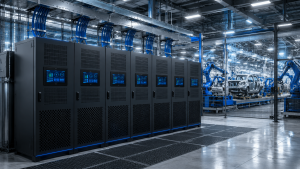
In a modern automated manufacturing facility, electricity is the lifeblood of production. However, as grids face increased strain from the integration of intermittent renewables and extreme weather events, power quality is declining. For industrial facility, a power disruption doesn't just mean the lights go out; a voltage sag lasting a fraction of a second can desynchronize a robotic assembly line, ruin a batch of pharmaceuticals, or cause severe tool damage.
A single power outage on a production line can cost millions in wasted raw materials, labor, and machine downtime. Implementing a robust industrial UPS system is the ultimate insurance policy against grid volatility. However, choosing the right system requires looking beyond standard commercial backup solutions and engineering a system tailored to harsh manufacturing environments.
Commercial vs. Industrial UPS: Understanding the Difference
Common mistake procurement departments make is treating a factory floor like an office data center. Commercial UPS systems are designed for clean, temperature-controlled environments with linear computer loads. An uninterruptible power supply industry solution must be built for the reality of the plant floor:- Environmental Resilience: Industrial units feature high Ingress Protection rated enclosures to withstand ambient dust, moisture, conductive particles, and oil mist.
- Thermal Tolerance: While commercial units require strict 20 to 25 degrees Celsius climates, industrial-grade systems can operate reliably in temperatures ranging from 0 degrees Celsius to over 50 degrees Celsius.
- Handling Non-Linear Loads: Industrial systems must survive heavy inrush currents (surges caused by electric motors starting up) and harmonic distortions generated by Variable Frequency Drives and welding equipment.
Step-by-Step: Choosing the Right Industrial UPS
Selecting the ideal system for production line power protection involves a three-step technical evaluation.1. Choose the Correct Topology
There are three main UPS topologies, but for industrial production lines, Double-Conversion Online UPS is the standard. In an online double-conversion architecture, the system continuously converts incoming AC utility power into DC power, and then inverts it back into a perfect, isolated AC sine wave. Because the inverter is always running and supplying the load, there is zero transfer time (zero milliseconds) when the main grid fails. This is critical for sensitive programmable logic controllers and CNC machinery that reset instantly during a standard transfer delay.2. Execute the UPS Capacity Calculation
To ensure your industrial power backup does not trip during a crisis, you must accurately calculate the required capacity.- Determine the Total Load: Add up the Volt-Amperes or Watts of all equipment connected to the line. Always use the nameplate rating or true RMS measurements.
- Account for the Power Factor: Modern industrial equipment operates at varying power factors. Ensure your UPS can handle the reactive power requirements without derating.
- Factor in Inrush Currents: If the UPS is backing up AC motors or pumps, the startup current can be 6 to 8 times the normal running current. Your UPS must be oversized or feature a high bypass capacity to handle these temporary surges.
- Add a Safety Margin: Always budget a 20 to 30 percent headroom for future facility expansions and to prevent the system from running at maximum thermal load.
3. Select the Right Energy Storage Medium
While Valve-Regulated Lead-Acid batteries have been the traditional choice, 2026 facility retrofits are heavily favoring Lithium-Ion and Flywheel energy storage.- Lithium-Ion: Offers a footprint that is up to 60 percent smaller, tolerates higher temperatures, and lasts up to 15 years, significantly dropping the long-term Total Cost of Ownership.
- Flywheels (Kinetic Energy): Ideal for short-duration ride-through applications. They offer instant power, require minimal maintenance, and have a lifespan exceeding 20 years, eliminating chemical battery risks.
Decentralized vs. Centralized UPS Architecture
When executing a factory UPS selection strategy, you must choose between backing up the entire facility from a single large unit or placing smaller, dedicated UPS systems at specific critical machines.- Centralized Approach: Features a large UPS located in a central electrical room. It is easier to maintain and monitor, but if the distribution lines inside the factory are damaged, downstream protection is lost.
- Decentralized Approach: Places localized UPS systems directly next to critical production segments. It provides targeted protection and prevents a single point of failure from taking down the entire facility, though it increases the number of maintenance points.