


For commercial and industrial enterprises in 2026, transitioning to a commercial solar energy system is no longer just an environmental initiative; it is a core financial strategy. However, the installation journey and the ultimate financial returns depend heavily on one initial decision: where the panels will be located.
When conducting a solar investment comparison, business leaders must evaluate the distinct differences between rooftop solar vs ground mounted solar. From the first site audit to the final grid connection, here is the step-by-step process, along with a detailed look at costs, efficiency, and expectations.
Step 1: Feasibility and Site Assessment
The installation process begins with a rigorous engineering assessment. The criteria differ drastically based on your chosen mounting strategy.- Rooftop Solar for Companies: The primary focus is structural integrity. Engineers must calculate the "dead load" (weight of the panels) and "wind uplift" limits of the existing roof. Additionally, modern LiDAR is used to analyze micro-shading from HVAC units or parapet walls. If the roof requires replacing within the next 5-10 years, it must be done before the solar installation.
- Ground Mounted Solar Investment: The focus here shifts to the earth. Geotechnical soil testing is required to determine the type of piling or concrete foundations needed. Topographical surveys assess land grading, and environmental impact studies ensure the project complies with local zoning laws.
Step 2: System Design and Efficiency Optimization
Once the site is vetted, the system is designed to maximize your solar ROI for business.- Rooftop Efficiency: System size is strictly limited by the available roof space. Furthermore, the orientation and tilt angle are often dictated by the roof's slope, meaning the panels may not face the optimal southern direction, resulting in a slightly lower specific yield.
- Ground-Mounted Efficiency: Ground systems offer precision engineering. Panels can be perfectly aligned and tilted. In 2026, most commercial ground-mounted systems utilize single-axis solar trackers, which follow the sun and increase energy yield by 20% to 30% compared to fixed rooftop systems.
Step 3: Permitting and Grid Interconnection
Obtaining legal permission is often the longest phase of a solar project.- Rooftop Permitting: Generally, rooftop installations face fewer bureaucratic hurdles since they utilize existing industrial structures. Grid interconnection is also simpler and cheaper, as the AC cable runs to the main distribution board are typically very short.
- Ground-Mounted Permitting: Utilizing vacant land often triggers stricter zoning laws. Additionally, if the solar array is located far from the facility’s main electrical room, it requires extensive trenching and thick, expensive cabling, which complicates the grid interconnection process.
Step 4: Installation and Commissioning
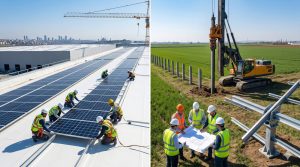
The physical construction phase requires careful logistics to avoid disrupting ongoing business operations.- Rooftop Construction: Involves cranes lifting materials onto the roof and installers working at heights. Special care is taken not to puncture the roof membrane, utilizing ballast mounts where possible.
- Ground-Mounted Construction: Heavy machinery is brought in for ramming steel posts into the ground. It is a more extensive civil engineering project but offers a safer, ground-level working environment for technicians, leading to faster assembly times per megawatt.
Costs and ROI: What to Expect in 2026
The ultimate decision hinges on the financial metrics.- Costs (CAPEX): Rooftop solar has a lower initial Capital Expenditure (CAPEX) because it avoids land acquisition, soil grading, and heavy foundation works. A ground-mounted system has a higher upfront cost due to civil works, trackers, and longer cable runs.
- Return on Investment (ROI): While rooftop solar offers a faster payback period due to lower initial costs, a ground-mounted system often provides a lower Levelized Cost of Energy (LCOE) over the 25-year lifespan. Because ground systems can utilize tracking technology and optimal orientation, their higher energy output eventually overtakes the initial setup costs, leading to massive long-term savings.