


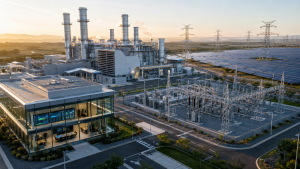
The global transition toward market liberalization, combined with severe grid capacity constraints, has fundamentally altered the power generation ecosystem. Traditionally dominated by state-owned utilities, electricity generation is increasingly shifting into the hands of private developers. Entering the independent power producer model (IPP) allows commercial enterprises and private investment groups to build, own, and operate decentralized energy assets while selling electricity directly to national grids or heavy industrial off-takers.
Operating an IPP power plant business transforms energy from a utility operational cost into a long-term, yield-generating financial asset. However, navigating the IPP space requires a deep understanding of project structuring, non-recourse project finance, long-term off-take contracts, and region-specific market dynamics.
The 4-Phase Lifecycle of an IPP Project
Developing a commercial IPP facility requires moving through four highly regulated project milestones:
-
Feasibility & Site Selection: Evaluating resource availability (solar irradiance, natural gas pipeline access, or wind profiles), conducting environmental impact assessments, and securing grid interconnection rights from local authorities.
-
Structuring Off-Take Agreements: Securing a long-term Power Purchase Agreement (PPA) with an off-taker. This contract underpins the entire financial structure of the asset.
-
EPC Execution & Commissioning: Contracting a single specialized Engineering, Procurement, and Construction (EPC) partner to deliver a turnkey power plant under fixed-price and guaranteed-performance terms.
-
Commercial Operation & Asset Management: Transitioning the plant into long-term commercial operations, leveraging predictive maintenance and remote monitoring to maximize plant availability over its 20-to-25-year lifespan.
Securing IPP Project Financing: Non-Recourse Structures
Because utility-scale energy projects require significant initial capital expenditures (CAPEX), developer capital alone is rarely sufficient. Instead, developers rely on IPP project financing structures—specifically non-recourse or limited-recourse project finance.
Under a non-recourse structure, institutional lenders evaluate the project based strictly on its projected cash flows rather than the developer's corporate balance sheet. To secure debt coverage:
-
The Debt-to-Equity Ratio: Projects are typically funded via 70 to 80 percent senior debt from commercial banks or International Financial Institutions (IFIs), with the remaining 20 to 30 percent provided as developer equity.
-
Debt Service Coverage Ratio (DSCR): Lenders require a predictable revenue stream to maintain a healthy DSCR, ensuring cash flows comfortably exceed debt servicing obligations even during periods of low generation.
Revenue Security: PPAs and Corporate Off-Take Models
To sell electricity to grid IPP setups or commercial entities, developers utilize two primary contractual frameworks to guarantee income:
-
Utility PPAs (State Off-Take): The IPP signs a long-term contract (typically 15 to 25 years) with a national state-owned power utility. These agreements often feature "Take-or-Pay" clauses, meaning the utility must pay for the contractually allocated generation capacity regardless of whether it dispatches the power onto the grid.
-
Corporate PPAs (Private Off-Take): Instead of selling to the state grid, the IPP sells power directly to large industrial consumers (such as mining operations, textile complexes, or chemical plants). Corporate PPAs offer industrial buyers predictable energy pricing and shield IPPs from sovereign state credit risks.
Emerging Growth Markets: Africa and Central Asia
While mature markets in Europe and North America face saturated grids and complex regulatory hurdles, decentralized power generation emerging markets offer the highest growth trajectory for IPPs.
-
Sub-Saharan Africa: Driven by rapid industrialization and significant energy deficits, countries across Sub-Saharan Africa are establishing clear IPP regulatory frameworks. Private developers are deploying solar-gas hybrid microgrids to power isolated industrial hubs and feed regional transmission lines.
-
Central Asia: Rich in natural gas resources and possessing vast open land for renewable integration, Central Asian nations are actively conducting international IPP auctions. Heavy investments in grid modernization and industrial expansion make Central Asia one of the fastest-growing regions for private power plant development.
By structuring resilient off-take agreements, partnering with experienced EPC contractors, and targeting high-growth markets, developers can build sustainable, high-yielding IPP assets that deliver long-term power security.